
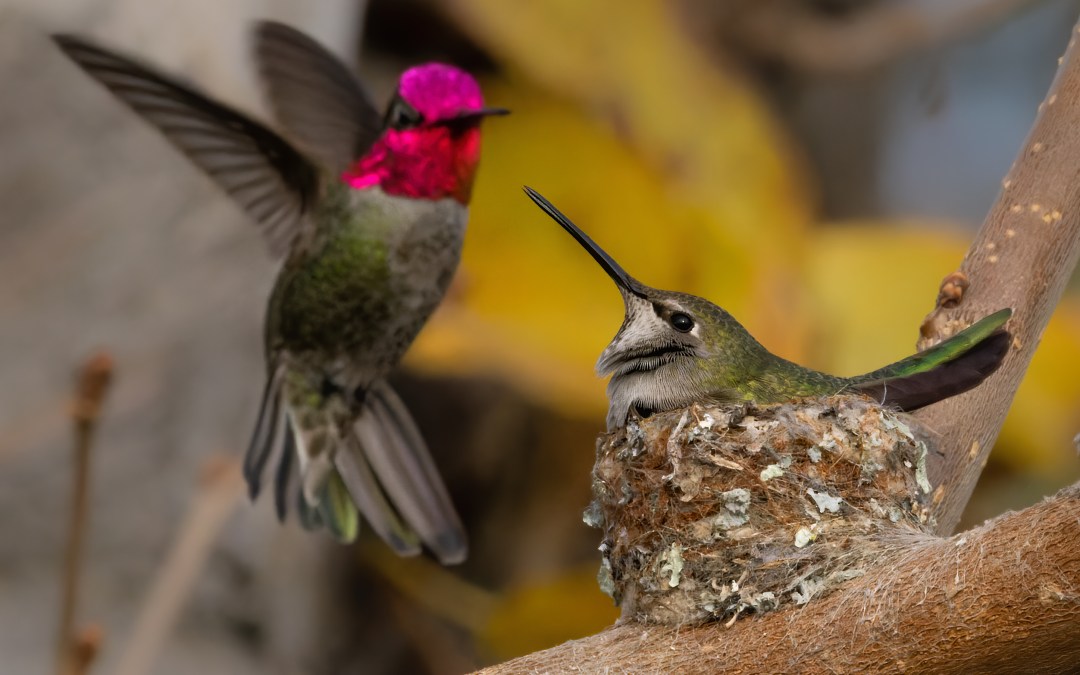
Anna’s Hummingbird | Shravan Sundaram | Audubon Photography Awards
This article was originally published in our Spring 2026 Issue of EarthCare Northwest, Birds Connect Seattle’s quarterly member newsletter. Read the full issue and become a member today.
by Ariel Shiley
It’s easy to miss a hummingbird nest tucked into a tree branch, and even easier to overlook the spider silk holding it all together. About the size of a walnut, a hummingbird nest is a compact cup carefully built from plant fibers, lichen, moss, twigs, and bits of leaves. What truly binds these materials into a sturdy, flexible home is spider silk.
Female hummingbirds are solely in charge of nest construction. They deliberately collect spiderwebs, weaving the sticky strands throughout their nests like a natural glue. Using their beaks and breasts, they gather spider silk and stretch it around both the nest and the supporting branch as an anchor. Spider silk is an ideal building material, as it is lightweight, incredibly strong, and elastic. This stretchiness is especially important because hummingbird nests aren’t static structures. As eggs hatch and chicks grow, the nest must expand without falling apart. Spider silk allows the nest to stretch gradually, accommodating growing chicks while maintaining its shape and grip on the branch.
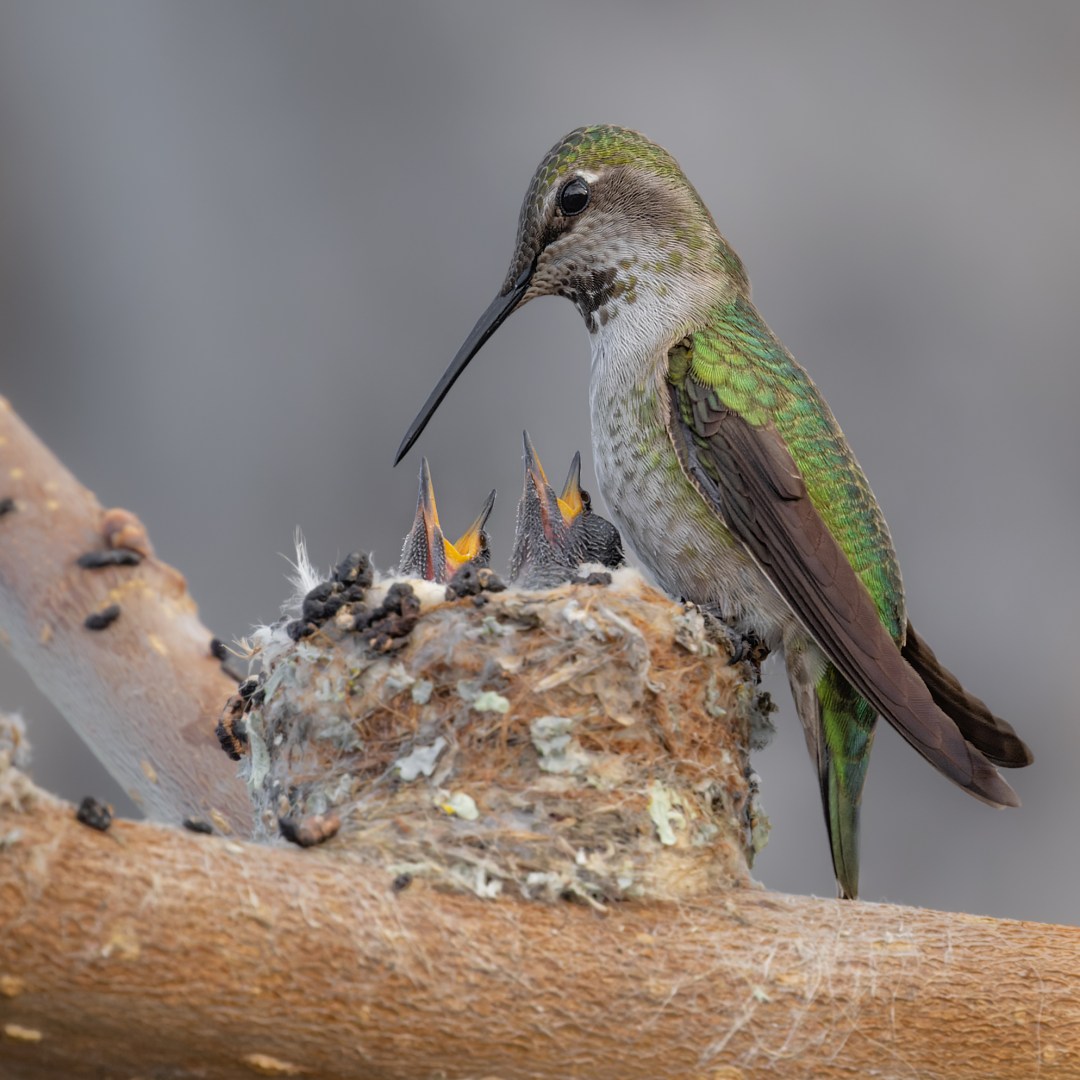
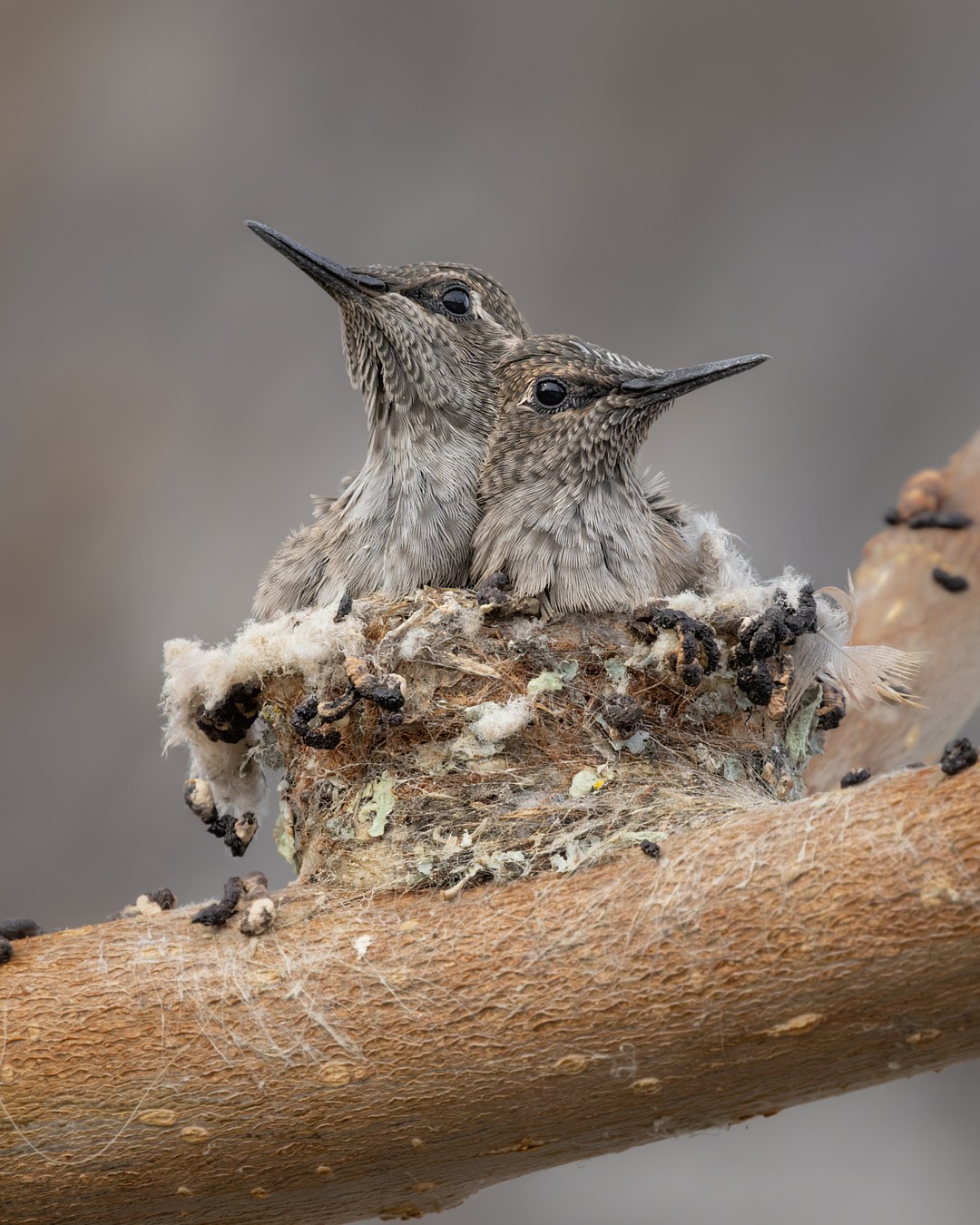
Anna’s Hummingbird nest stretching as chicks grow.
Shravan Sundaram | Audubon Photography Awards
Beyond its flexibility, spider silk is one of the toughest materials found in nature. Pound for pound, spider silk is considered 5-times stronger than the strength of steel. Its fibers can bend and stretch extensively without snapping, which helps hummingbird nests withstand the wind, rain of the Pacific Northwest, and the constant movement of active chick. This durability ensures the nest remains secure throughout the nesting season (February – April), despite being exposed to the elements.
Humans have long recognized the remarkable properties of spider silk as well. In ancient times, spider webs were used as bandages to help stop bleeding. Today, scientists study spider silk for applications ranging from medical sutures to biodegradable materials. Hummingbirds, however, figured out its usefulness long before modern research caught up.
By using spider silk, hummingbirds demonstrate a remarkable understanding of their environment, selecting materials that perfectly suit their needs. Their nests, while delicate, are also engineering marvels. The next time you spot a hummingbird darting through the trees, take a closer look nearby. You may just find a camouflaged, silk-bound nest, holding the next generation of Anna’s or Rufous Hummingbirds.
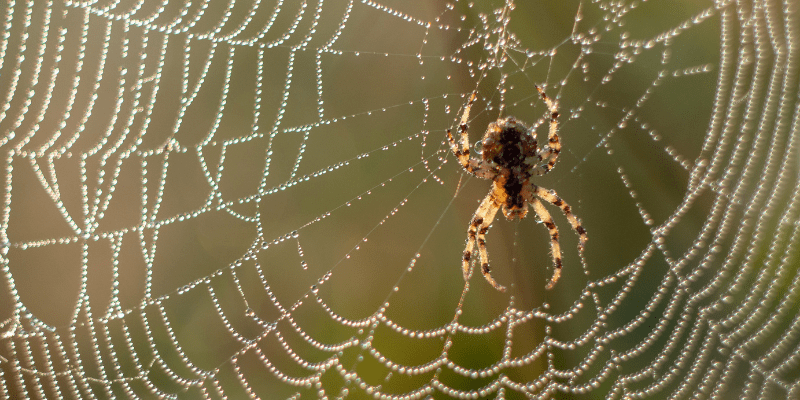
Spider silk from orb weavers is commonly used in hummingbird nests. Jan S Martino | Canva

About Ariel Shiley
Member
Ariel Shiley is a Washington native whose love for the natural world began with studying rocks in her backyard and volunteering at the PAWS Wildlife Center in Lynnwood. She is a recent graduate of Western Washington University, where she earned her master’s degree in environmental science, and is beginning her career in wildlife conservation. A newer member of Bird Connect, Ariel is grateful for the chance to connect with a community of fellow bird lovers.
References and Additional Resources
- Birds and Blooms: Everything You Need to Know About Hummingbird Nests
- Branković, M., Zivic, F., Grujovic, N., Stojadinovic, I., Milenkovic, S., & Kotorcevic, N. (2024). Review of Spider Silk Applications in Biomedical and Tissue Engineering. Biomimetics, 9(3), 169.
- Goel, A. Surgical Sutures—A Review. Off. Sci. J. Delhi Ophthalmol. Soc. 2015, 26, 159–162.
- Science: Spider Silk is Five Times Stronger than Steel
- Treehugger: How Hummingbirds Use Spider Silk to Build Better Nests
- Xu, G.; Toh, G.W.; Du, N.; Liu, X.Y. Spider Silk: The Toughest Natural Polymer. In Natural Polymers. 1: Composites; RSC Green Chemistry; RSC Publishing: Cambridge, UK, 2012; ISBN 978-1-84973-402-8.
Related Articles
Built to Catch Bugs: Adaptations of Insect-Eating Birds
From mosquito-snatching swallows to barbed tongue woodpeckers, discover how insect-eating birds are perfectly built to catch their next snack.

Volunteer Spotlight: Jordan Juranek
Meet a Birds Connect Seattle volunteer! Discover their favorite birding spots, from Union Bay to Seward Park, their passion for Wood Ducks, and why they love leading outings with our NextGen team.
Discovering Seattle’s Blue Jay: The Steller’s Jay
Think you spotted a Blue Jay in Seattle? Look closer—it was likely a bold, mischievous Steller’s Jay, a striking local favorite with a personality as loud as its call.