
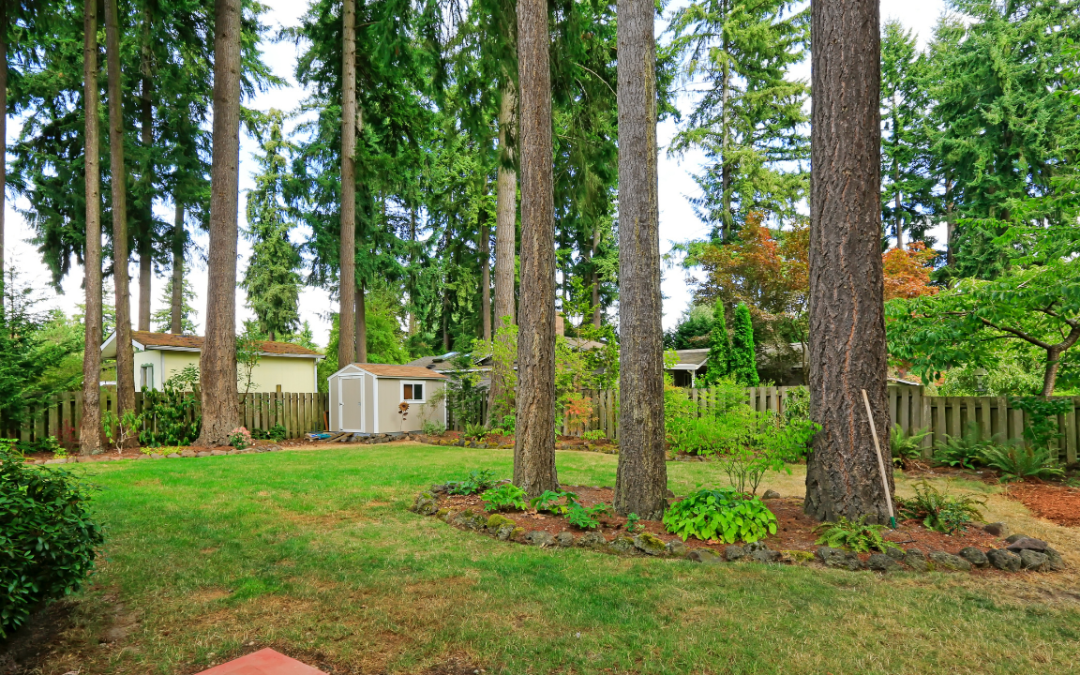
Mature trees on a private lot in Seattle
Birds Connect Seattle was named as a stakeholder in an Executive Order from Mayor Harrell calling for more incentives to preserve trees on private property. That Mayor Harrell prioritized this issue during his reelection campain shows that urban forestry is becoming a voting issue in Seattle.
Elevating tree protection onto the political agenda has taken years of sustained advocacy by many individuals and organizations. We’re encouraged by this progress as we continue working to protect mature trees, expand our urban forest, and ensure that the benefits of tree canopy are distributed equitably across the city.
Why this matters now
Seattle is aiming to grow its tree canopy cover to 30% by 2037, but the most recent tree canopy cover assessment shows we’re backsliding: Seattle’s tree canopy cover was 28.1 % in 2021, down from 28.6 % in 2016.
The assessment also revealed a troubling equity gap: communities of color and communities with lower incomes not only had less tree cover to begin with, they also lost more tree canopy over that period.
While this new executive order is a step in the right direction, we’ll need much more to reverse tree canopy loss and address the worsening canopy equity conditions, especially in the face of accelerating climate change.
What we’re celebrating and what we’re committing to
With this executive order in place, we are celebrating:
-
A clearer signal from the city government that trees on private property are just as valuable as those in parks or other public lands.
-
A reinforcement of our shared commitment to protect mature trees and grow the canopy in neighborhoods that have been historically underserved.
-
The result of years of your support: advocacy, planting projects, community outreach, policy work. Without you, our community of advocates and members, outcomes like this would not be possible.
But we also know this is not the finish line. We’re committing to:
-
Working with the city and Mayor-elect Wilson to develop new policies for property owners, developers, and public agencies to improve tree preservation on private land.
- Drawing on our firsthand experience to help develop recommendations for a new city-supported urban tree conservation easement program.
-
Emphasizing the need for increased tree-planting and protection in communities where canopy cover is lowest to address widening tree canopy disparities.
-
Supporting policy and regulatory tools that align growth and housing needs with tree canopy preservation—so that our city can grow and remain green and resilient.
Economic incentives too often favor tree removal over preservation, accelerating canopy loss and exacerbating environmental inequities. Birds Connect Seattle has been exploring strategies to counter this trend. Last year, when we sold our former Wedgwood headquarters, we worked with the buyer to place a conservation easement on the property, protecting its mature trees and native plant garden in perpetuity. We are eager to share our experience and help the city develop a conservation easement program.
Related Articles
Aerial Insectivores in Decline: What 18 Years of Neighborhood Bird Project Data Reveals
Our skies are changing. New analysis of 18 years of Neighborhood Bird Project data shows aerial insect-eating birds, like swallows and swifts, are declining locally, with some species down more than 90%.
What’s driving the drop, and what can we do to help?
Built to Catch Bugs: Adaptations of Insect-Eating Birds
From mosquito-snatching swallows to barbed tongue woodpeckers, discover how insect-eating birds are perfectly built to catch their next snack.
Volunteer Spotlight: Jordan Juranek
Meet a Birds Connect Seattle volunteer! Discover their favorite birding spots, from Union Bay to Seward Park, their passion for Wood Ducks, and why they love leading outings with our NextGen team.